Ice Maker Not Working? Eight Things to Check
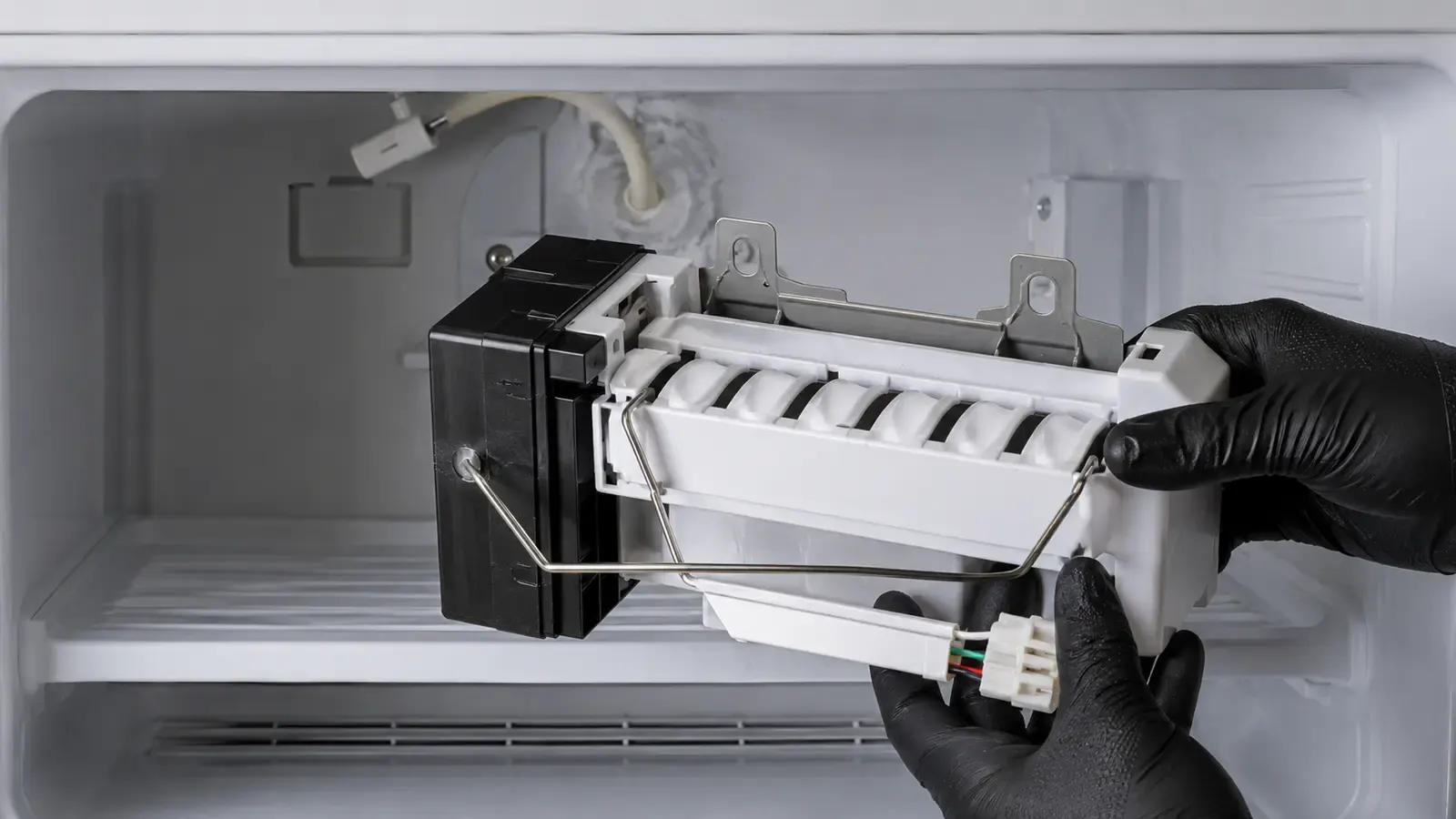
Ice makers fail more often than any other component in a refrigerator, and for a reason worth understanding: they combine water, moving parts, a heater and sub-zero temperatures in one small assembly. Everything about that is demanding.
The good news is that most failures are in the water supply rather than the ice maker itself, and those are the cheap ones.
1. Is the ice maker actually switched on?
Start here, because it costs nothing and it catches people regularly.
Most ice makers have either a wire bail arm that lifts to stop production, or a switch in the control panel. A bail arm knocked upward by a bag of frozen peas will stop production entirely, and nothing about the fridge indicates why.
Check the panel setting too — some models disable ice production automatically in certain modes.
2. Check the water supply
No water in, no ice out. Work along the path:
- Shut-off valve behind or under the fridge, fully open
- Water line not kinked where the fridge was pushed back into place
- Water filter not overdue — this is the single most common cause of degraded production
- Dispenser test: if your fridge dispenses water and that works, supply reaches the appliance and the fault is downstream
That last test is diagnostically useful. Water dispensing normally but no ice narrows things considerably.
3. Check the freezer temperature
An ice maker will not complete its harvest cycle if the freezer is too warm. The compartment needs to be at about −18°C.
Put a thermometer in and leave it a few hours. A freezer sitting at −10°C has a cooling problem that happens to present as an ice problem, and fixing the ice maker will achieve nothing.
4. Look for a frozen fill tube
The fill tube delivers water into the ice mould. If it freezes, water backs up and production stops — usually with an icicle visible where the tube enters the compartment.
A frozen fill tube is often a symptom rather than a cause: a fill tube heater has failed, or the compartment is running colder than intended, or water is arriving too slowly and freezing on the way.
5. The Samsung French-door fault
This deserves its own section, because it is the single most common refrigerator fault we attend across the entire GTA.
On many Samsung French-door models the ice room freezes over completely — not loose cubes, a solid slab of ice around the auger and up into the mechanism. Production stops, and the owner usually finds a video suggesting a hair dryer.
That works. For about ten days.
The reason it comes back is that humid air is reaching a compartment that should be sealed from the fresh food section. The seal has compressed unevenly, the defrost path in the ice room is blocked, and every thaw cycle simply resets the clock. Samsung has issued service guidance on this pattern.
A proper fix addresses the seal and the defrost path, not the ice. We wrote up a downtown condo job where the owner had already defrosted it once themselves.
If you have a Samsung French-door fridge and your ice maker has frozen twice, the ice maker is not your problem.
6. Check the cubes you are still getting
Cube quality is the earliest warning you get, and it appears long before production stops.
| What you see | What it means |
|---|---|
| Small or hollow cubes | Short fill — filter overdue or inlet valve restricted |
| Cloudy cubes | Minerals and trapped air — hard water, filter due |
| Cubes stuck together | Slow usage, or the compartment cycling above freezing |
| Cubes with an odour | Filter overdue, or food stored uncovered nearby |
| No cubes but water dispenses | Ice maker assembly, harvest cycle or fill tube |
Small cubes are worth acting on. They mean the water path is already restricted, and it will not improve on its own.
7. Listen for the harvest cycle
Every few hours the ice maker runs a harvest: the mould heats slightly to release the cubes, the auger turns, and the cubes drop. It is audible.
If you never hear it, the module or its thermostat has stopped cycling. If you hear it but no ice arrives, the mould is empty — back to the water supply.
8. Give a new installation time
An ice maker installed or reconnected within the last day is not broken yet.
Allow 24 hours for the first proper harvest. Discard the first two or three batches — ice made while the lines are new picks up taste from the tubing, and people conclude the water is bad when it is simply new.
When to call a pro
Call when:
- The freezer holds temperature but there is still no ice
- The ice room has frozen over more than once
- The fill tube keeps freezing
- Water dispenses normally but the ice maker never harvests
- Cube size has dropped and a new filter did not restore it
Valves, filters and ice maker modules are mid-range parts, and this is generally an economical repair. What it should not be is repeated: if you have thawed the same ice maker twice, the third thaw will not be different.
Our refrigerator repair page covers the broader fridge symptoms, and wine cooler and ice maker repair covers standalone units, which fail differently from the ones built into a fridge.
When to call a pro
If the checks above did not solve it, or the fault involves sealed refrigeration, mains wiring or a control board, that is our line. The service call is $120 plus HST, you approve a written quote before any work, and the repair carries a 60-day parts & labour warranty.
About the authors
Fast Appliance Repair Pro has been repairing residential appliances across Toronto and the GTA since 2013 — 4,530+ completed jobs. Everything in this guide comes from work orders, not from a content brief.
About our teamQuick answers
Why does my Samsung ice maker keep freezing over?
Humid air is reaching the ice compartment past a seal that no longer sits flush, and it refreezes within weeks of every thaw. Melting the ice treats the symptom — the seal and the defrost path are the cause.
How long should a new ice maker take to produce ice?
Give it 24 hours for the first full harvest, and discard the first two or three batches. Ice made while the lines are new picks up taste from the tubing.
Why are my ice cubes small or hollow?
Short fill, which means the water path is restricted — usually an overdue filter or a partly blocked inlet valve. Cube size is the earliest warning sign of a supply problem, well before production stops.