Dishwasher Not Draining? Fix It in Six Steps
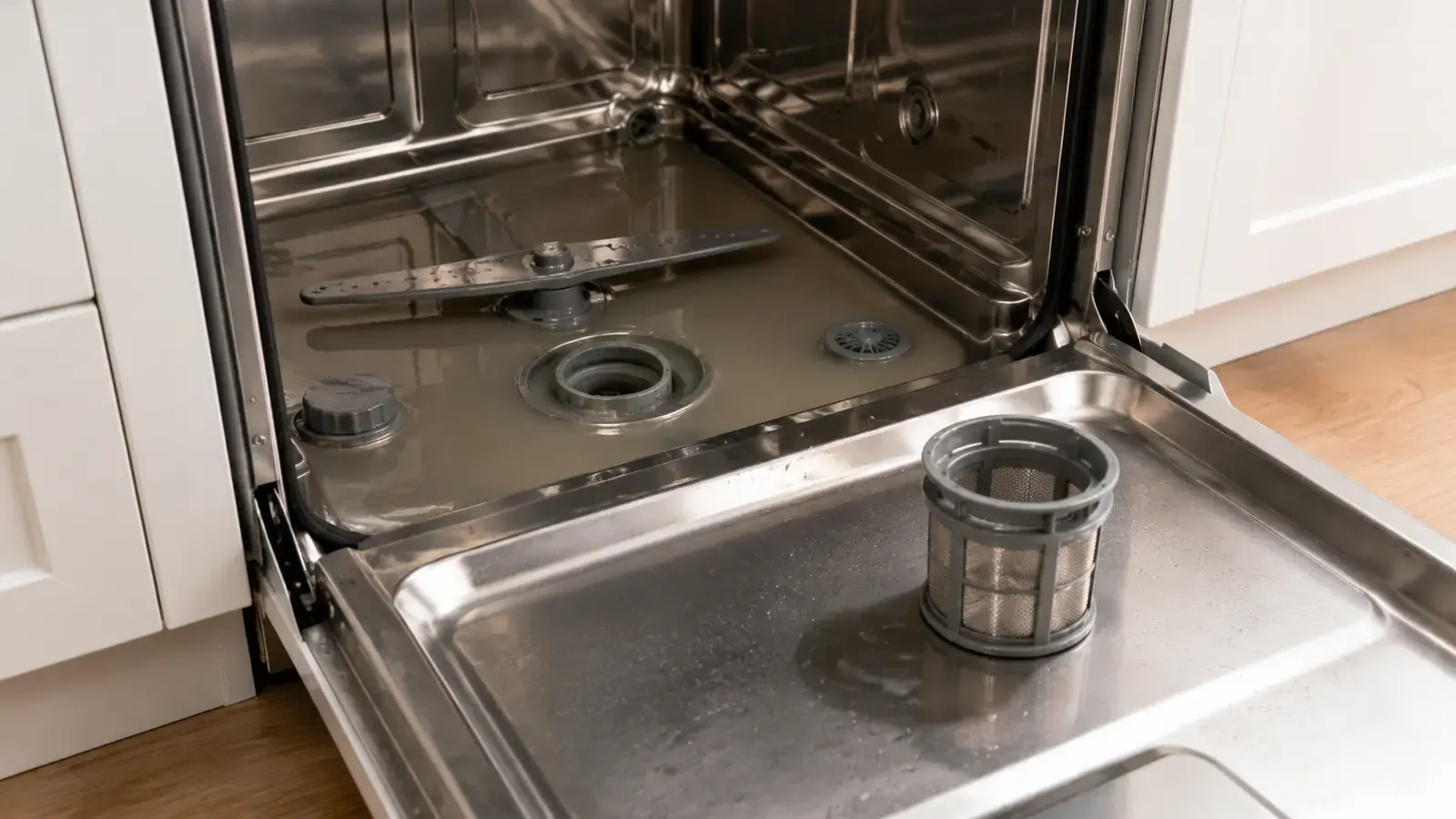
Standing water at the end of a cycle is the most common dishwasher fault there is, and it is also the one most likely to be solved in twenty minutes with a towel and a screwdriver.
This is the order a technician works through it. Follow it and you will either fix the problem or know exactly what to tell whoever you call.
Before you start: turn the dishwasher off at the wall or the breaker. You will have your hands inside a machine that expects to be able to start a pump.
Step 1 — Bail out the standing water
You cannot inspect anything through several centimetres of dirty water.
Lay towels down, then scoop the water out with a cup into a bucket. The last of it comes up with a sponge or a wet-vac if you have one. It is unpleasant for about four minutes and it makes everything after this straightforward.
Step 2 — Clean the filter assembly
This is the fix about half the time. The filter sits in the base of the tub, usually as a cylindrical part you twist and lift out, sometimes with a flat mesh screen beneath it.
Take both out. Rinse under a hot tap, use a soft brush on the mesh, and clear anything caught in the housing they sit in. What comes out is typically food debris, seeds, labels from jars and — often — fragments of glass.
Refit firmly. A filter that is not locked down properly lets debris straight through to the pump, which turns a cheap problem into a more expensive one.
Run a short cycle. If the water drains, you are done.
Step 3 — Check the drain hose
Behind or under the machine, the drain hose runs to the sink trap or the garbage disposal.
Look for a kink — hoses get crushed when a dishwasher is pushed back into place after servicing or a kitchen change. Straighten anything obvious.
Then check the high-loop. The hose should rise up under the countertop before descending to the drain connection. That loop stops waste water flowing back into the machine. If the hose runs straight along the floor, that is an installation fault, and it is one of the most common things we find in newer homes — the machine has been draining badly since the day it was fitted.
Step 4 — Check the disposal and the air gap
If your dishwasher drains into a garbage disposal:
- Run the disposal. A partial blockage there stops the dishwasher draining too.
- Check the knockout plug. New disposals ship with a plug sealing the dishwasher inlet, and it has to be removed during installation. If it was missed, the dishwasher cannot drain at all — and it presents exactly like a failed pump. This catches people constantly in new builds.
If you have an air gap — the small chrome cylinder on the sink deck — lift the cover and clean it out. They block with debris and stop drainage completely.
Step 5 — Look at the sink trap
The dishwasher drains into the same plumbing as your sink. If the sink is slow, the dishwasher will be too.
Run the tap. If the sink drains sluggishly, the trap is your problem rather than the appliance, and clearing it fixes both.
Step 6 — Check the drain pump
This is the last step you can do yourself, and only on machines where the pump is accessible from inside the tub after removing the filter and a cover plate. Check your manual; on some models it is not reachable without pulling the machine.
With the power off, look for anything jamming the impeller. Glass fragments are the usual culprit and the reason we recommend checking the sump after anything breaks in the machine.
Be careful. Broken glass in a pump housing is exactly as sharp as it sounds. Gloves.
If the impeller is chipped or scored, cleaning it is not enough — a damaged impeller moves water badly and the fault returns within weeks.
Error codes worth decoding
| Code | Brand | Meaning |
|---|---|---|
| E24 | Bosch, Siemens | Drain restricted — usually the filter |
| E25 | Bosch, Siemens | Drain pump blocked — needs opening |
| E15 | Bosch, Siemens | Water in the base pan, Aquastop tripped |
| 5C / 5E | Samsung | Not draining |
| OE | LG | Not draining |
| F9 E1 | Whirlpool, KitchenAid | Drain taking too long |
E24 versus E25 is the distinction worth remembering: the first is often yours to fix, the second is generally not.
When to call a pro
Stop and call if:
- The filter, hose, disposal and trap are all clear and it still will not drain
- The pump hums but moves no water — it is jammed or failed
- You see E15 or any leak warning. Water has reached the base pan, and in a condo that becomes your neighbour’s ceiling before it becomes your problem
- The impeller is visibly damaged
- There is water under the machine as well as in it
A drain repair is one of the less expensive things we do. The service call is $120 plus HST and covers the full diagnosis, you approve a written quote before any work, and the repair carries a 60-day parts and labour warranty.
What we would genuinely rather you did first is Step 2. We talk people through it on the phone several times a week, and when it works nobody pays for a visit — which is how it should be.
More detail on symptoms and what a visit involves is on our dishwasher repair page, and there is a real Square One job where the filter was clean and the pump was not.
When to call a pro
If the checks above did not solve it, or the fault involves sealed refrigeration, mains wiring or a control board, that is our line. The service call is $120 plus HST, you approve a written quote before any work, and the repair carries a 60-day parts & labour warranty.
About the authors
Fast Appliance Repair Pro has been repairing residential appliances across Toronto and the GTA since 2013 — 4,530+ completed jobs. Everything in this guide comes from work orders, not from a content brief.
About our teamQuick answers
Is standing water in a dishwasher normal?
A small amount in the sump — a centimetre or so around the filter — is normal and keeps the seals from drying out. Water covering the base of the tub after a completed cycle is not.
Can I run the dishwasher with standing water in it?
It will attempt the cycle and usually fail the same way, and dirty water recirculating over clean dishes achieves nothing. Clear the blockage first — it is generally a twenty-minute job.
What does E24 mean on my Bosch dishwasher?
The drain is restricted, usually at the filter. About half of these clear with a filter clean the owner can do. E25 is different — that is the pump itself, and it needs opening up.