Why Is My Freezer Frosting Up?
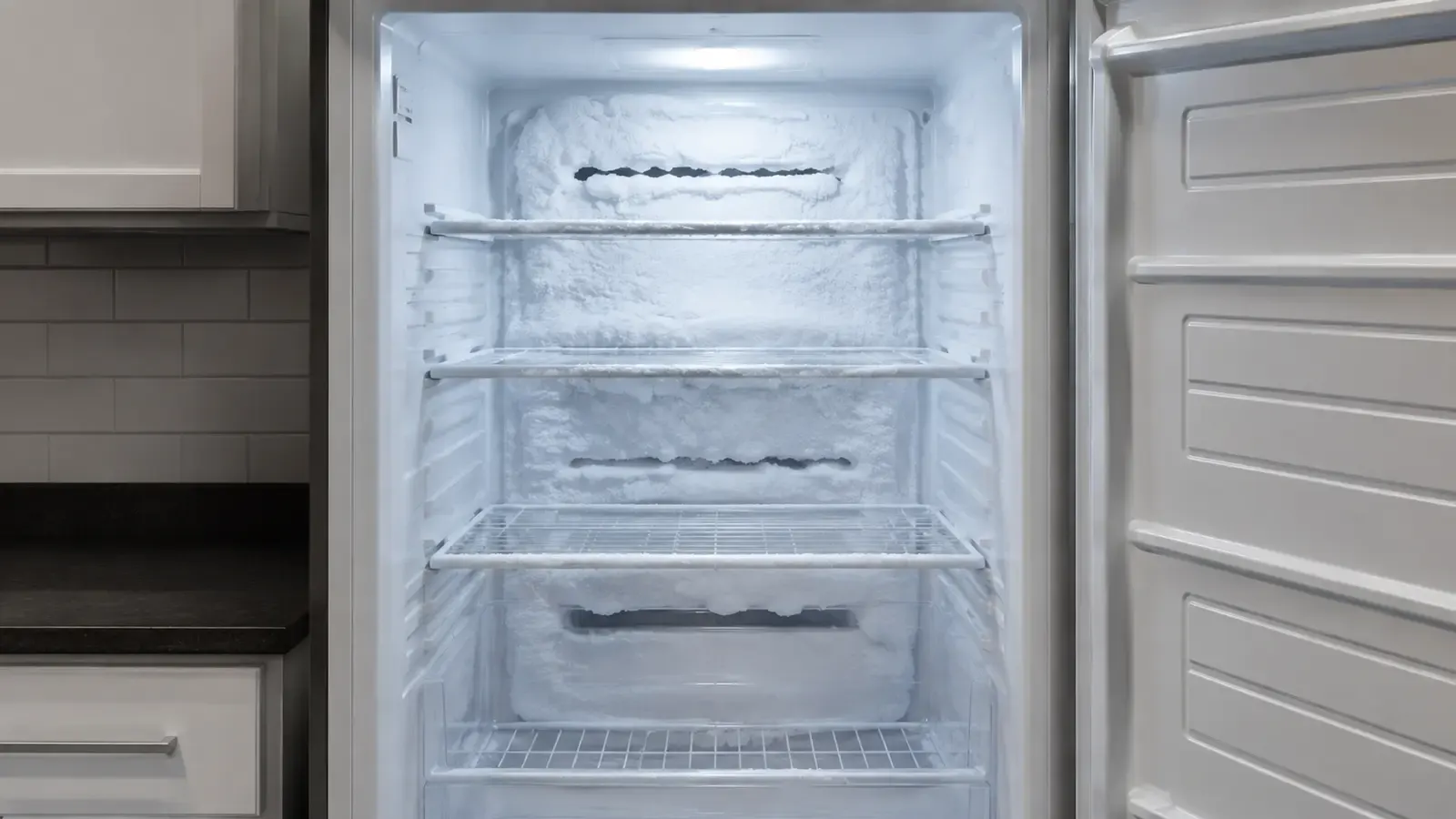
There are two kinds of freezer, and the difference determines whether frost is normal or a fault.
A manual-defrost freezer — most chest freezers — accumulates frost by design. You defrost it once or twice a year and that is the deal you made when you bought it.
A frost-free freezer — nearly all uprights, and every freezer compartment in a modern fridge — has an automatic system that clears the coil several times a day. If yours is building a sheet of ice on the back wall, that system has stopped working.
How automatic defrost actually works
Understanding this makes the diagnosis obvious.
Cold air is produced at the evaporator coil, hidden behind the rear panel of the freezer compartment. Air circulating past it deposits moisture as frost on the coil — that is unavoidable physics, not a defect.
To stop the coil icing solid, the freezer runs a defrost cycle every few hours:
- A defrost timer or the control board decides it is time.
- A defrost heater wrapped around the coil warms it just enough to melt the frost.
- A defrost thermostat cuts the heater once the coil reaches temperature.
- Meltwater runs down a drain tube to a pan near the compressor, where it evaporates.
Break any one of those four and ice builds until air can no longer pass the coil. The compartment warms even though the compressor is running constantly, because the cold air has nowhere to go.
Which part has failed
Defrost heater. The most common failure. Tests as an open circuit — no continuity — and produces no heat at all. Ice builds steadily from the moment it fails.
Defrost thermostat. Fails either way. Stuck open means the heater never runs; stuck closed means it runs too long and the compartment warms.
Defrost timer or control board. Stops advancing the cycle. Often accompanied by a heater that fails soon after, because erratic cycling shortens its life.
Blocked drain tube. The one people miss. Even with a working heater, if meltwater cannot leave it refreezes at the bottom of the compartment and works its way up. This is why fixing the heater alone often fails — the ice comes straight back.
Door seal. Not part of the defrost system, but a poor seal admits warm humid air continuously, which loads the system beyond what it can clear. Test it with a sheet of paper: close the door on it and pull. If it slides out freely, that section is not sealing.
What you can check yourself
The paper test on the door seal. All the way around, not just at the handle. Gaskets harden with age and stop compressing long before they look damaged.
Whether the door is being left ajar. Overloaded shelves and items catching the seal are more common than people think, especially in a second freezer that is packed full.
The drain. On some models the drain hole is visible at the base of the rear panel inside the compartment. If you can see it and it is iced over, that is informative.
The frost pattern. A light dusting spread evenly is usually a door or usage issue. A thick sheet concentrated on the back wall behind the panel is the defrost system.
What not to do
Do not chip the ice out. The evaporator coil sits directly behind that ice, and it is thin-walled tubing under pressure. Puncture it and you have converted a $250 defrost repair into a sealed-system failure that on most freezers is not worth fixing at all.
Do not attack it with a hair dryer at close range. Plastic components inside a freezer warp at surprisingly low temperatures, and warped ducting causes airflow problems that outlast the ice.
If you need to defrost manually, unplug it, empty it, open the door and put towels down. Time is the safe tool.
A note on second freezers
The freezer in the garage or the basement is the one that fails quietly. Nobody opens it daily, so it can drift warm for weeks before anyone notices — and in a garage, summer heat makes it worse.
Two habits help: put a thermometer inside where you can see it without opening the door, and glance at it whenever you pass. A freezer should sit at about −18°C. Anything consistently above −12°C is degrading food quality even if nothing has visibly thawed.
When to call a pro
Call when:
- Ice returns within days or weeks of a manual defrost
- The compartment is not holding around −18°C
- The compressor runs constantly
- There is water pooling under or inside the unit
- You can hear the fan striking ice
A defrost repair is a mid-range job — heater, thermostat and timer are all reasonably priced parts — and it is well worth doing on a freezer that is otherwise sound. What we always do alongside it is clear the drain, because leaving it blocked means the ice comes back regardless of how good the new heater is.
Our freezer repair page covers the other symptoms, and if you are wondering whether a unit this age is worth the money, repair or replace has the arithmetic.
When to call a pro
If the checks above did not solve it, or the fault involves sealed refrigeration, mains wiring or a control board, that is our line. The service call is $120 plus HST, you approve a written quote before any work, and the repair carries a 60-day parts & labour warranty.
About the authors
Fast Appliance Repair Pro has been repairing residential appliances across Toronto and the GTA since 2013 — 4,530+ completed jobs. Everything in this guide comes from work orders, not from a content brief.
About our teamQuick answers
Is frost normal in a frost-free freezer?
No. A light dusting after leaving the door open is fine, but a sheet of ice on the back wall means the automatic defrost system has stopped working. If you are defrosting manually more than once a season, something has failed.
Can I just chip the ice out?
Please do not. Chipping punctures the evaporator coil, and a punctured coil turns a modest defrost repair into a sealed-system failure that usually is not worth fixing. Thaw it instead.
Why does my freezer frost up again days after defrosting?
Because the drain is blocked as well as the defrost system having failed. Meltwater has nowhere to go, so it refreezes in place. Both need addressing or the ice returns within weeks.