Repair or Replace? The 50% Rule and Real Numbers
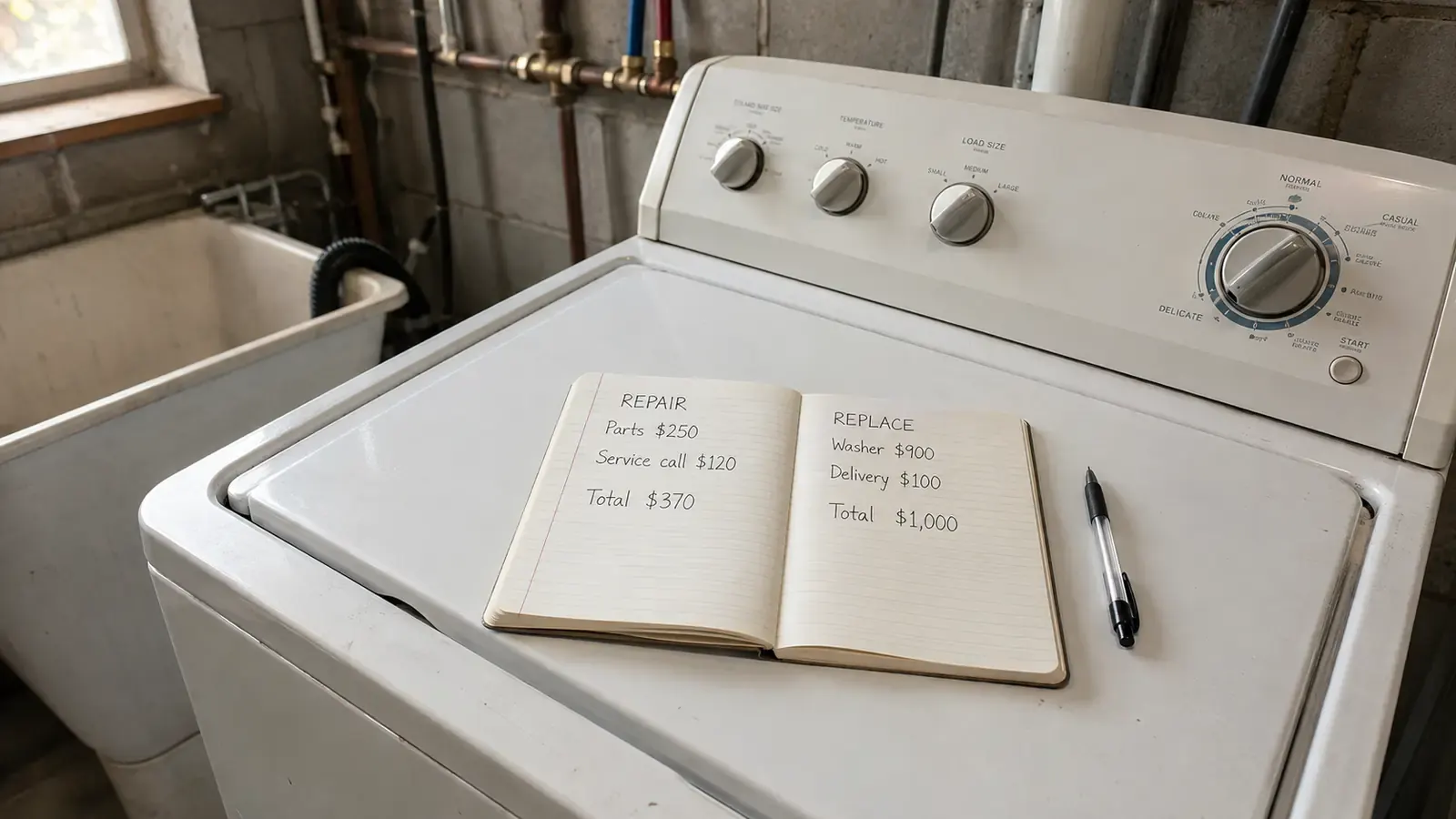
Every appliance eventually reaches the point where fixing it stops making sense. Working out where that point sits is genuinely difficult from the outside, and companies with an interest in selling you a repair are not always the best guide.
Here is the framework we use, including the jobs we turn down.
The 50% rule, stated properly
The rule most people have heard is: if the repair costs more than half of a comparable new appliance, replace it.
That is a good starting point, but it is incomplete on its own. Used alone it condemns machines that should be kept and saves ones that should not. The full version has two conditions:
Replace when the repair exceeds 50% of replacement cost and the appliance is past the halfway point of its expected service life.
Both halves matter. A $400 repair on a two-year-old $900 washer is worth doing — the machine has a decade left. The same $400 on an eleven-year-old washer is not.
Expected service life, by appliance
These are the ranges we work with. Canadian households, normal use.
| Appliance | Typical service life | Halfway point |
|---|---|---|
| Refrigerator (standard) | 10–15 years | ~6 years |
| Refrigerator (built-in, premium) | 18–25 years | ~10 years |
| Freezer (chest or upright) | 12–18 years | ~7 years |
| Washer (front or top load) | 10–13 years | ~6 years |
| Washer (premium European) | 18–22 years | ~10 years |
| Dryer | 12–15 years | ~7 years |
| Dishwasher | 9–12 years | ~5 years |
| Oven / range (electric) | 13–18 years | ~8 years |
| Cooktop (induction) | 10–15 years | ~6 years |
| Range hood | 12–18 years | ~7 years |
| Microwave (built-in) | 8–10 years | ~4 years |
Note how far the premium rows sit from the standard ones. A Miele washer at twelve is two-thirds through a long life; a mid-range washer at twelve is at the end of a short one. Applying one rule to both is how people replace appliances with a decade left in them.
Worked examples
A dishwasher, 7 years old, failed drain pump. Repair around $220. New comparable unit $800. Repair is 27% of replacement, and the machine is just past halfway. Repair.
A washer, 11 years old, failed drum bearings. Repair around $650. New comparable unit $1,100. Repair is 59% of replacement on a machine near the end of its life. Replace — and this is the repair we most often advise against.
A Sub-Zero built-in, 14 years old, condenser fan and cleaning. Repair around $410. Replacement $12,000+ and cabinetry work. Repair is 3% of replacement on a machine barely past halfway. Repair, without hesitation.
A countertop microwave, any age, failed magnetron. Repair around $220. New unit $150. Replace. We decline these on the phone.
A wall oven, 9 years old, failed control board. Repair around $600. New unit $2,200 plus installation and possible cabinet modification. Repair is 27%, the machine is around halfway, and replacement carries hidden costs. Repair — but check parts availability first.
When NOT to repair
Some situations are not worth your money regardless of what the percentage says:
- Sealed-system work — compressor or refrigerant — on a fridge or freezer over ten years old. The cost approaches a new appliance and the rest of the machine is the same age.
- Drum bearings on a mid-range washer at or past ten years. Labour-heavy, and the total lands near replacement.
- Any countertop appliance. A replacement costs less than the service call.
- Tub leaks on older dishwashers. Substantial labour, uncertain outcome.
- An appliance that has already had two major repairs in the past two years. That pattern rarely reverses, and you are funding it one part at a time.
- A machine where the part is discontinued. Sometimes an equivalent exists; often it does not, and waiting on a phantom order helps nobody.
Reasons to repair that the percentage misses
Built-in and integrated appliances. Replacing a fitted unit means matching an opening, a trim kit and often cabinetry. A repair that looks marginal on price alone becomes obviously correct once a carpenter is involved.
Older cabinet openings. Kitchens from the seventies and eighties do not always have the standard 24-inch dishwasher opening every modern machine assumes. We measure before recommending replacement for exactly this reason.
Premium machines mid-life. Miele, Sub-Zero, Wolf and Thermador are engineered for roughly twice the service life of mass-market equivalents, and parts remain available for a long time.
The environmental arithmetic. A repair keeps a functional appliance out of landfill. That is not a financial argument, but it is a real one, and for many people it tips a borderline decision.
What we do on the visit
We diagnose first, then give you the number and the recommendation together — including when the recommendation is not to proceed. If the honest answer is that your machine is not worth fixing, you pay the service call and keep the diagnosis. Take it to another company for a second opinion if you want; the information is yours.
That happens often enough that it is worth stating plainly: we would rather lose a job than sell a repair we would not buy ourselves. A $700 repair on a fourteen-year-old washer is not a favour to anyone.
If you are weighing this up right now, our pricing page explains what a diagnosis costs and what happens afterwards, and the case studies show real jobs with the numbers attached — including one where the honest advice was to replace rather than repair.
When to call a pro
If the checks above did not solve it, or the fault involves sealed refrigeration, mains wiring or a control board, that is our line. The service call is $120 plus HST, you approve a written quote before any work, and the repair carries a 60-day parts & labour warranty.
About the authors
Fast Appliance Repair Pro has been repairing residential appliances across Toronto and the GTA since 2013 — 4,530+ completed jobs. Everything in this guide comes from work orders, not from a content brief.
About our teamQuick answers
What is the 50% rule for appliance repair?
If the repair costs more than half the price of a comparable new appliance, and the unit is past the halfway point of its expected life, replacement usually wins. Both conditions matter — an expensive repair on a young machine is often still worth doing.
Does a repair extend an appliance beyond its normal lifespan?
Replacing a worn component restores it to roughly where it should be for its age, not beyond. A new pump on a twelve-year-old washer does not make it a two-year-old washer, and that is the honest way to think about it.
Are new appliances less reliable than old ones?
Mechanically they are more efficient and better built in places. What has changed is electronics: modern machines have control boards, sensors and connectivity that older units did not, and those add failure points that did not exist before.