Oven Baking Unevenly? Calibration and Fixes
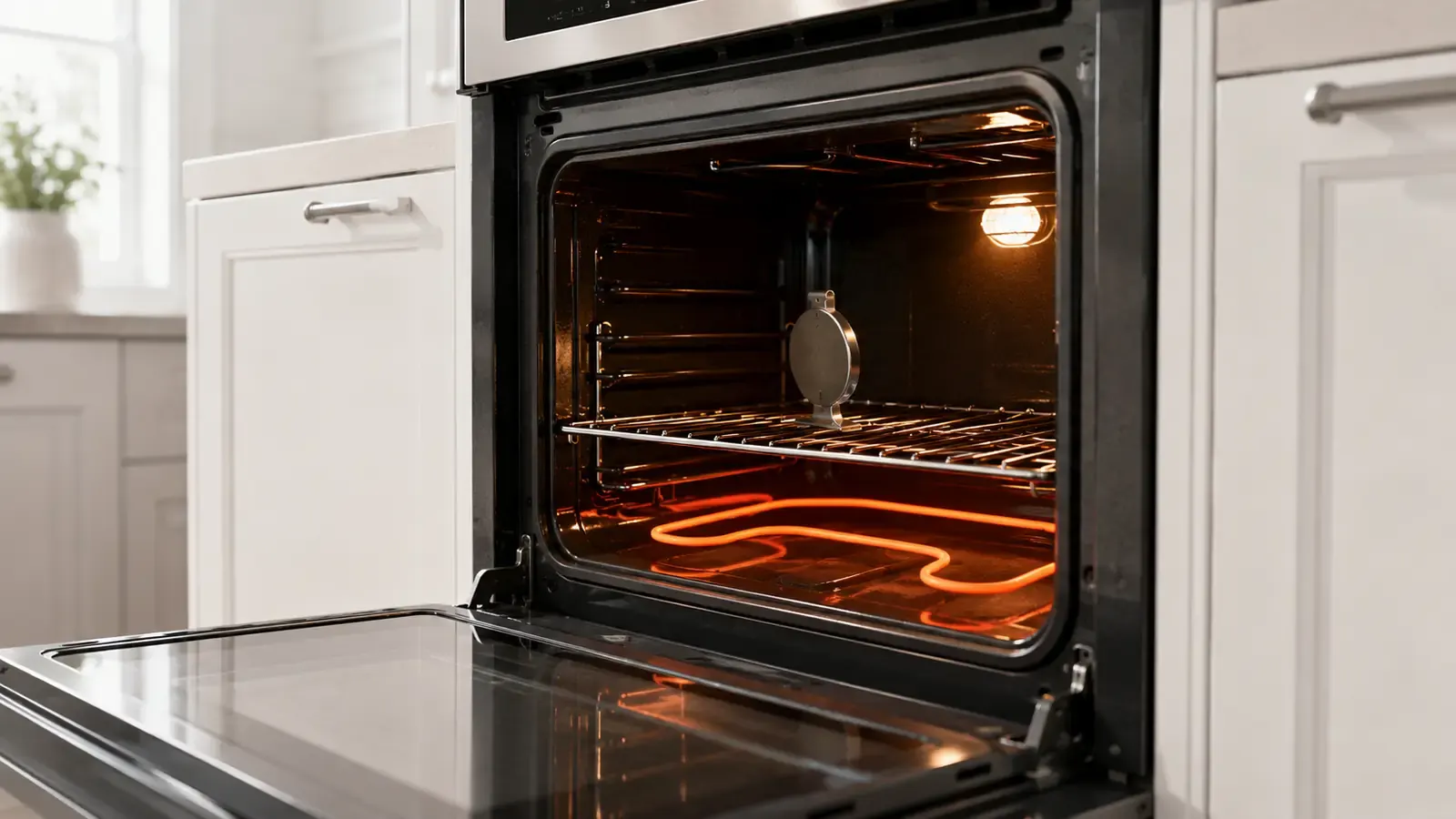
“The oven bakes unevenly” covers three genuinely different faults, and telling them apart before anyone touches your appliance saves both time and money.
It might be running off temperature. It might be running at the right average while swinging wildly. Or it might be perfectly accurate and simply moving air badly. Each has a different cause and a different cost.
First: measure it properly
Do not trust the display. An oven’s own reading comes from the same sensor that may be the problem, which makes it the least reliable witness available.
You need an independent oven thermometer — the kind that hangs from a rack, available for under $20.
The test:
- Put the thermometer in the centre of the middle rack.
- Set the oven to 175°C (350°F) and let it preheat fully.
- Wait a further 20 minutes after the preheat signal. Ovens overshoot and settle.
- Read it without opening the door if the thermometer is visible through the glass.
- Read again at 30 and 45 minutes.
Three readings matter far more than one. A single reading at preheat tells you almost nothing about how the oven behaves across an hour of actual baking.
What the results mean
Consistently 10–20°C low or high, steady across all three readings. Calibration drift. The oven is stable, just wrong. Many models allow a user calibration offset in the settings menu — check the manual. If yours does not, we can adjust it.
Readings wandering by 15°C or more between checks. The temperature sensor is failing. It is reporting inaccurately and inconsistently, so the board cannot hold a steady temperature. Inexpensive part, quick swap.
Accurate at the centre but food browning unevenly. Airflow, not temperature. That points at the convection fan, the door seal or rack position.
Reads correctly but takes far longer than it should to preheat. One element may have failed. Many ovens use both bake and broil elements to preheat, so losing one still gets you there — slowly.
Airflow problems and how to spot them
If the temperature is right and the baking still is not, work through these:
Convection fan. It should run whenever a convection mode is selected. A fan slowing as its bearings wear circulates air poorly and produces exactly the classic complaint — one side of the tray browning while the other stays pale. A rising whine under load is the audible warning.
Door seal. Test it the same way you would a fridge: close the door on a sheet of paper and pull. If it slides out freely anywhere around the frame, heat is escaping there — and it will show up as uneven browning on that side. Gaskets harden long before they look worn.
Rack position and crowding. Two trays on adjacent racks block airflow between them. So does a tray that nearly fills the rack width. This is technique rather than fault, but it accounts for a real share of complaints.
Reflective versus dark bakeware. Dark metal absorbs more heat and browns faster. If the unevenness followed a change of tray, that is your answer.
The self-clean warning
Worth stating in any oven article: self-clean is hard on your oven.
The cycle runs the cavity far above normal cooking temperatures, and that heat is what kills control boards, thermal cut-outs and door latch motors. We see a distinct run of these failures after every major holiday — people clean the oven before a large dinner and lose it the night before.
If you use it, run it several days before you actually need the oven. If your range sits in a tight alcove with poor ventilation, consider not using it at all.
What we do on a calibration call
We do not adjust by feel. The oven gets an independent probe and runs a full cycle while we log temperature against the setpoint over time. That log answers the question definitively:
- Consistent offset → calibration
- Wandering readings → sensor
- Correct centre, uneven distribution → convection fan or seal
- Slow to reach temperature → element
The measurement takes most of the visit, and it is the part worth paying for. Replacing a sensor on an oven that needed calibrating fixes nothing, and the reverse is equally true.
Rough costs
Ranked from least to most expensive:
- Calibration adjustment — labour only
- Temperature sensor — inexpensive part, quick labour
- Door gasket — moderate part, straightforward
- Bake or broil element — inexpensive part, and check the terminal block behind it, as a Maple job showed
- Convection fan motor — mid-range
- Control board — the expensive end, and on a built-in wall oven the number that decides repair versus replace
When to call
If the oven is within ±10°C and holding steady, you do not have a fault — you have an oven, and adjusting your recipes by a few degrees is entirely reasonable.
Call when readings wander, when one side consistently browns faster, when preheating has become noticeably slower, or when an F-code appears. Sensors and calibration are among the cheaper repairs in a kitchen, and it is worth knowing which one you need before anyone quotes a board.
Our oven and range repair page has the other symptoms, including what F-codes mean on each major brand.
When to call a pro
If the checks above did not solve it, or the fault involves sealed refrigeration, mains wiring or a control board, that is our line. The service call is $120 plus HST, you approve a written quote before any work, and the repair carries a 60-day parts & labour warranty.
About the authors
Fast Appliance Repair Pro has been repairing residential appliances across Toronto and the GTA since 2013 — 4,530+ completed jobs. Everything in this guide comes from work orders, not from a content brief.
About our teamQuick answers
How accurate should an oven be?
Within about ±10°C of the setting is normal and will not ruin your baking. Beyond that, calibration or the temperature sensor needs attention.
Can I calibrate my oven myself?
Many ovens have a user calibration offset in the settings menu, typically adjustable by up to ±35°F or ±20°C. Check the manual. It only helps if the oven is consistently off — if the temperature wanders, the sensor is the problem.
Why does one side of my tray brown more than the other?
Usually a convection fan that has slowed, or a door seal letting heat escape on one side. Both are measurable, and both are inexpensive to correct compared with a control board.