Why Is My Fridge Not Cooling? 12 Causes and Fixes
A refrigerator that hums along quietly while the milk goes warm is one of the more frustrating faults in a kitchen, because nothing looks broken. The compressor runs, the light comes on, the display shows the temperature you set. The cold just is not there.
Almost every no-cooling call we attend across Toronto and the GTA comes down to one of twelve causes, and they fall into a clear order — cheapest and most common first. Work through them in that order and you will either fix it in twenty minutes or know exactly what to tell us when you call.
Start here: is it cooling at all, or cooling badly?
Before anything else, establish which problem you have, because they lead in different directions.
Put a glass of water in the fridge with a thermometer in it and leave it four hours. A fridge should hold about 3–4°C, a freezer about −18°C.
- Freezer cold, fridge warm — an airflow or defrost problem. Most likely on this list.
- Both warm, compressor running — a sealed-system or start-component problem.
- Both warm, nothing running — power, thermostat or control board.
That single test eliminates two-thirds of the possibilities before you touch a screwdriver.
The twelve causes, in the order we check them
1. Condenser coils packed with dust
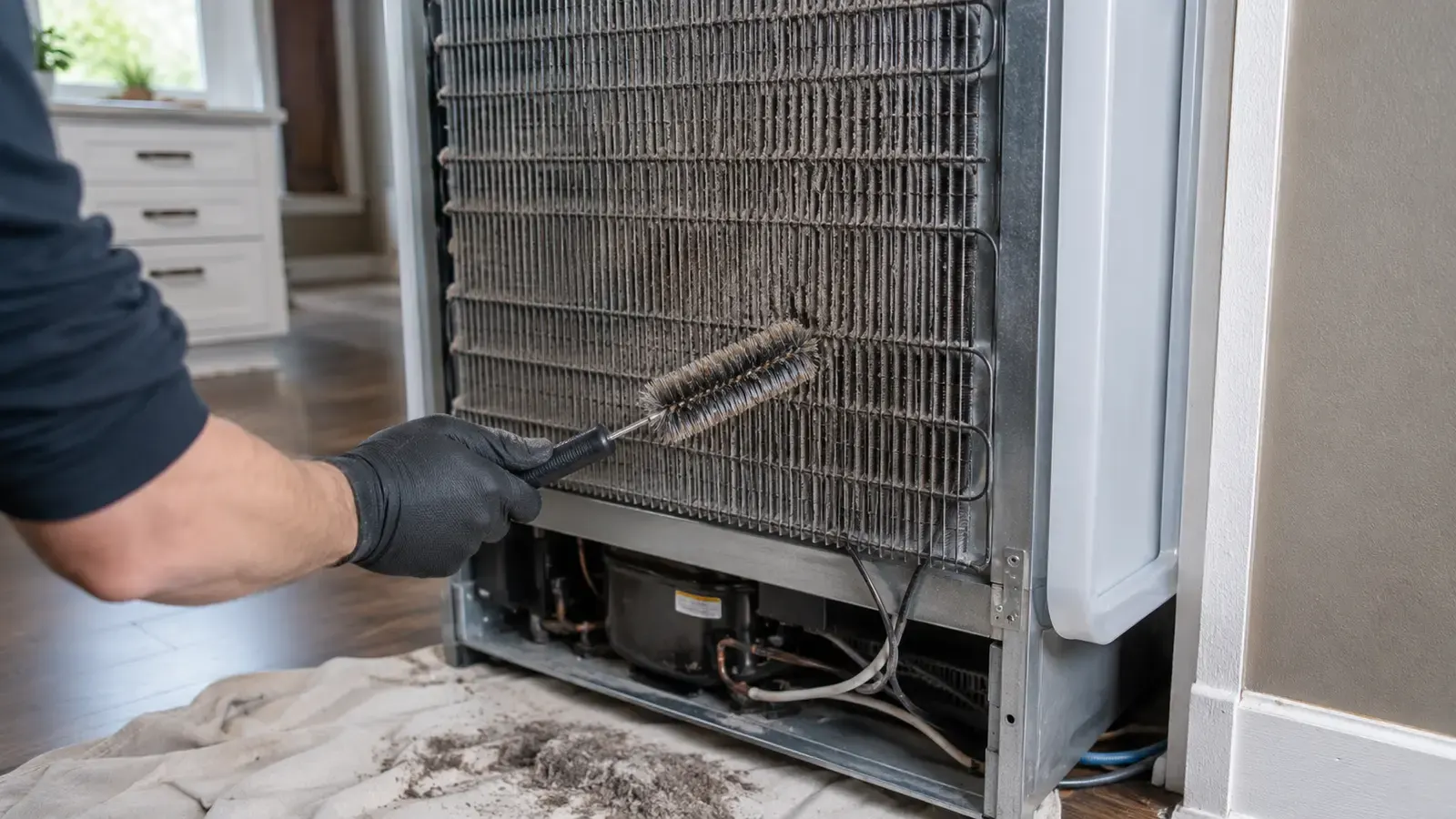
The single most common cause we see, and the cheapest to fix. The coils shed heat, and when they are blanketed in dust and pet hair they cannot. The compressor runs constantly and still loses ground.
Pull the fridge out, remove the lower rear or front kickplate panel, and look. If the coils look grey and furry, vacuum them thoroughly. In a home with pets this deserves doing twice a year.
2. Condenser fan not running
The fan sits next to the compressor and pushes air across those coils. If it has seized or its motor has failed, the result looks identical to blocked coils. With the fridge running, listen at the back — you should hear it. A fridge that runs hot to the touch at the back with no fan noise has a dead fan.
3. Evaporator fan seized
This one is inside the freezer, and it is the usual answer to “freezer is cold, fridge is warm”. The evaporator fan moves cold air from the freezer into the fresh food section. If it stops, the freezer stays cold and the fridge slowly warms up.
Open the freezer and press the door switch by hand. You should hear the fan spin up. Silence, or a grinding noise, points here.
4. Defrost system failure and an iced-over evaporator
If the defrost heater, thermostat or timer fails, frost builds on the evaporator coil until it becomes a solid block of ice that air cannot pass through. Symptoms: freezer works, fridge does not, and you may hear the fan hitting ice.
Test: unplug the fridge for 24 hours with the doors open, then run it again. If it cools normally for a day or two and then fails the same way, you have a defrost fault, not an airflow one.
5. Air damper stuck closed
The damper meters cold air from the freezer to the fridge. Stuck closed, the fresh food section never gets cold air. Stuck open, the opposite happens and your lettuce freezes.
6. Start relay or capacitor failed
If the compressor clicks every few minutes and does nothing, the start relay is the classic suspect. The compressor tries, fails to start, thermal-overloads, cools down, tries again.
7. Door seals no longer sealing
Perished, warped or dirty gaskets let warm humid air in continuously. Test with a sheet of paper: close the door on it and pull. If it slides out with no resistance, that section is not sealing. Older units in narrow kitchens, where doors get knocked and levered, are the usual offenders.
8. Fridge not level
A fridge that leans forward has doors that swing shut by themselves; one that leans back does not close fully. Almost no kitchen floor is truly level, and a bubble level plus the adjustable feet solves it.
9. Thermistor drifted out of range
The sensor tells the board what temperature it is seeing. When it drifts, the board acts on wrong information — cooling when it should not, or not cooling when it should. It is an inexpensive part and a quick swap.
10. Overpacking and blocked vents
Cold air has to circulate. A fridge packed wall to wall, or with boxes shoved against the rear vent, develops warm zones no repair will fix. Find the vents and keep them clear.
11. Control board fault after a power event
Power flickers are common in older Toronto buildings, and control boards do not always come back cleanly. Unplug for ten minutes and restore. If it behaves afterwards, note the date — a board that needs this more than once is failing.
12. Sealed system: refrigerant leak or compressor
The expensive one, and the reason we diagnose properly before quoting. Symptoms: compressor runs constantly, back of the unit is warm but the freezer never gets truly cold. This is not a DIY repair, and on a fridge over ten years old it is usually the point where replacement wins.
What you can safely do yourself
Vacuum the condenser coils, check the door seals, level the unit, clear the vents, and try a ten-minute power cycle. Those five cover a real share of no-cooling calls and cost nothing.
When NOT to repair
Some situations are not worth your money, and we would rather say so than sell you a repair:
- A sealed-system failure on a unit over ten years old — the cost approaches a new fridge.
- A compressor replacement on a budget-tier unit, where the repair can exceed half the replacement price.
- A fridge that has already had two major repairs in the past two years. That pattern rarely reverses.
- Cosmetic-plus-mechanical failures together on an old unit — the sum is never worth it.
Everything else — fans, sensors, dampers, boards, seals, defrost components — is usually a sensible repair that buys several more years.
Before you call, have this ready
The model and serial number, on a sticker inside the fresh food compartment or behind the kickplate. A photo of that sticker means we bring the right part on the first visit rather than ordering it afterwards. Also useful: how long it has been warm, and whether the freezer is still cold. Those two answers tell us most of what we need before we arrive.
When to call a pro
If the checks above did not solve it, or the fault involves sealed refrigeration, mains wiring or a control board, that is our line. The service call is $120 plus HST, you approve a written quote before any work, and the repair carries a 60-day parts & labour warranty.
About the authors
Fast Appliance Repair Pro has been repairing residential appliances across Toronto and the GTA since 2013 — 4,530+ completed jobs. Everything in this guide comes from work orders, not from a content brief.
About our teamQuick answers
How long can food stay in a fridge that is not cooling?
Four hours is the safe limit for refrigerated food held above 4°C. A full freezer holds safe temperature for about 48 hours unopened, half-full for about 24. Keep the doors shut — every opening costs you hours.
Can a fridge fix itself after being unplugged?
Sometimes, and it is worth trying. A control board confused by a power event can clear with 10 minutes unplugged. If the fridge cools normally afterwards and stays that way for a week, that was the fault. If it fails again, the board or a sensor is on its way out.
Is it worth repairing a fridge that stopped cooling?
Usually yes. Fans, thermistors, defrost components and start relays are all modest repairs. The exception is sealed-system work — compressor or refrigerant — on a unit over ten years old, where the cost approaches a replacement.