The call
A Kingsway homeowner rang on a Tuesday morning: the fridge side of their Sub-Zero 650 had drifted warm over about a week, but the freezer was still rock solid. Everything in the fresh food section was sitting around 11°C — cold enough that nothing had obviously spoiled, warm enough that it all had to go soon.
They had already done the sensible things. Checked the temperature setting, moved food away from the rear vents, and unplugged the unit overnight to see if it would reset. None of it made a difference, which is useful information: it ruled out the easy answers before we arrived.
The unit was built into cabinetry, as these almost always are, in a kitchen renovated about eight years ago. Panel-ready front, flush with the run, and no obvious way to get behind it without taking the surround apart.
Diagnosis
The first thing worth saying about a Sub-Zero 650 is that it has two separate sealed systems — one for the fridge, one for the freezer. That is why the freezer can be perfect while the fridge fails completely, and it narrows the diagnosis considerably before the toolbox is even open.
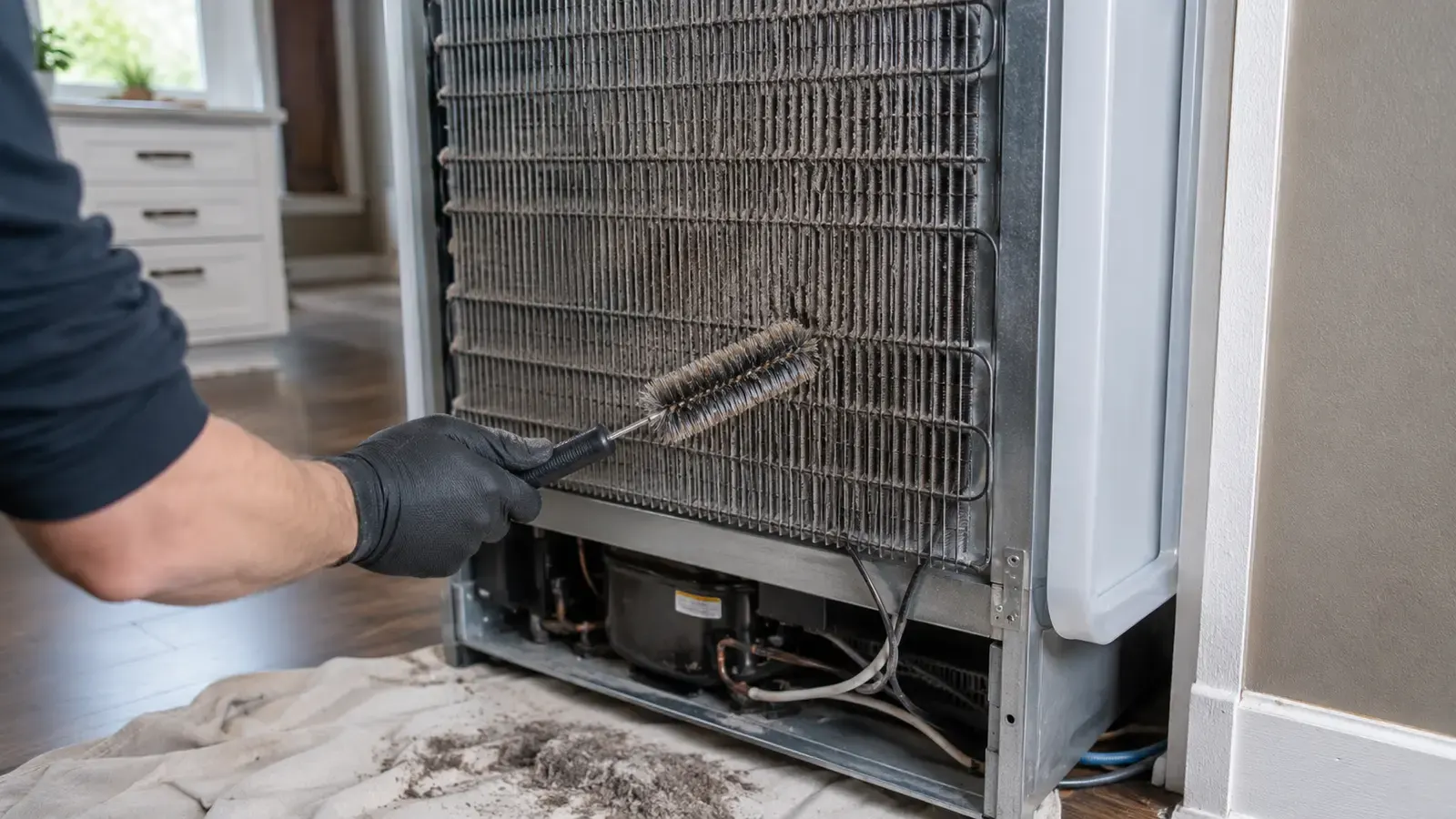
We pulled the grille and found the condenser packed solid with dust and pet hair. Not merely dirty — genuinely blanketed, to the point where you could not see the fins. That alone will make a unit run warm.
But a blocked condenser rarely takes out only one side, so we kept going:
- Condenser fan running, but slowly, with audible bearing noise
- Fresh food evaporator fan turning freely — not the problem
- Fridge compartment compressor drawing current but cycling short
- Freezer side drawing normal current and holding −19°C throughout
The picture was consistent. The fridge-side compressor was fighting a heat rejection problem it could not win, and the condenser fan — the component whose entire job is moving air across those fins — was on its way out.
The fix
Two things, in order:
- Vacuum condenser cleaning. Not a wipe with a brush — the coil was cleared properly, front and back, along with the compressor compartment and the fan shroud. On a unit this neglected, what comes out is usually persuasive on its own.
- Condenser fan motor replaced with the factory part. A generic motor of roughly the right size will physically fit and spin, but the airflow specification on these units is not approximate, and a slightly weaker fan just recreates the original fault more slowly.
We refitted everything, ran the unit for the better part of an hour, and logged the fresh food compartment coming down through 7°C and settling at 3.5°C. Two hours on site in total, most of it cleaning and waiting for temperature rather than turning screws.
Outcome
The fridge was back to normal by that evening. We left the owner with one piece of advice worth more than the repair: book condenser cleaning every six to twelve months. On a built-in Sub-Zero it is the single most valuable maintenance there is, and it costs a fraction of what it prevents.
Nobody had ever told us the condenser needed cleaning. Eight years and we did not know it was there.
That is not unusual, and it is not the owner’s fault — the grille hides it, and nothing in daily use suggests it exists. A dust-choked condenser makes the compressor work harder on every single cycle, which is how an appliance designed for twenty years of service ends up needing sealed-system work at twelve.
The repair cost $412 before HST. A sealed-system failure on this unit would have run several times that, and it was heading there.
Cost breakdown
| Service call & diagnostic | $120 |
|---|---|
| Parts | $178 |
| Labour | $114 |
| Total (before HST) | $412 |