The call
An Agincourt family home, ten-year-old Whirlpool electric dryer, tumbling with no heat at all. Clothes came out exactly as damp as they went in.
The detail that shaped the whole visit came out on the phone: this was the second time in about a year. A different company had replaced the thermal fuse eleven months earlier, it had worked fine since, and now it had done the same thing again.
That is not a coincidence and it is not a bad part. A thermal fuse blowing twice in a year is a symptom with a cause behind it, and replacing the fuse again without finding that cause would simply have booked a third visit at the owner’s expense.
Diagnosis
The thermal fuse is a safety device. It sits in the exhaust path and blows when the machine overheats — which happens when hot, moist air cannot leave fast enough. So the question is never “why did the fuse fail” but “why did the dryer overheat”.
We confirmed the obvious first:
- Thermal fuse open circuit — no continuity, as expected
- Heating element measured within specification, undamaged
- Cycling thermostat within tolerance
- Supply voltage correct on both legs at the terminal block
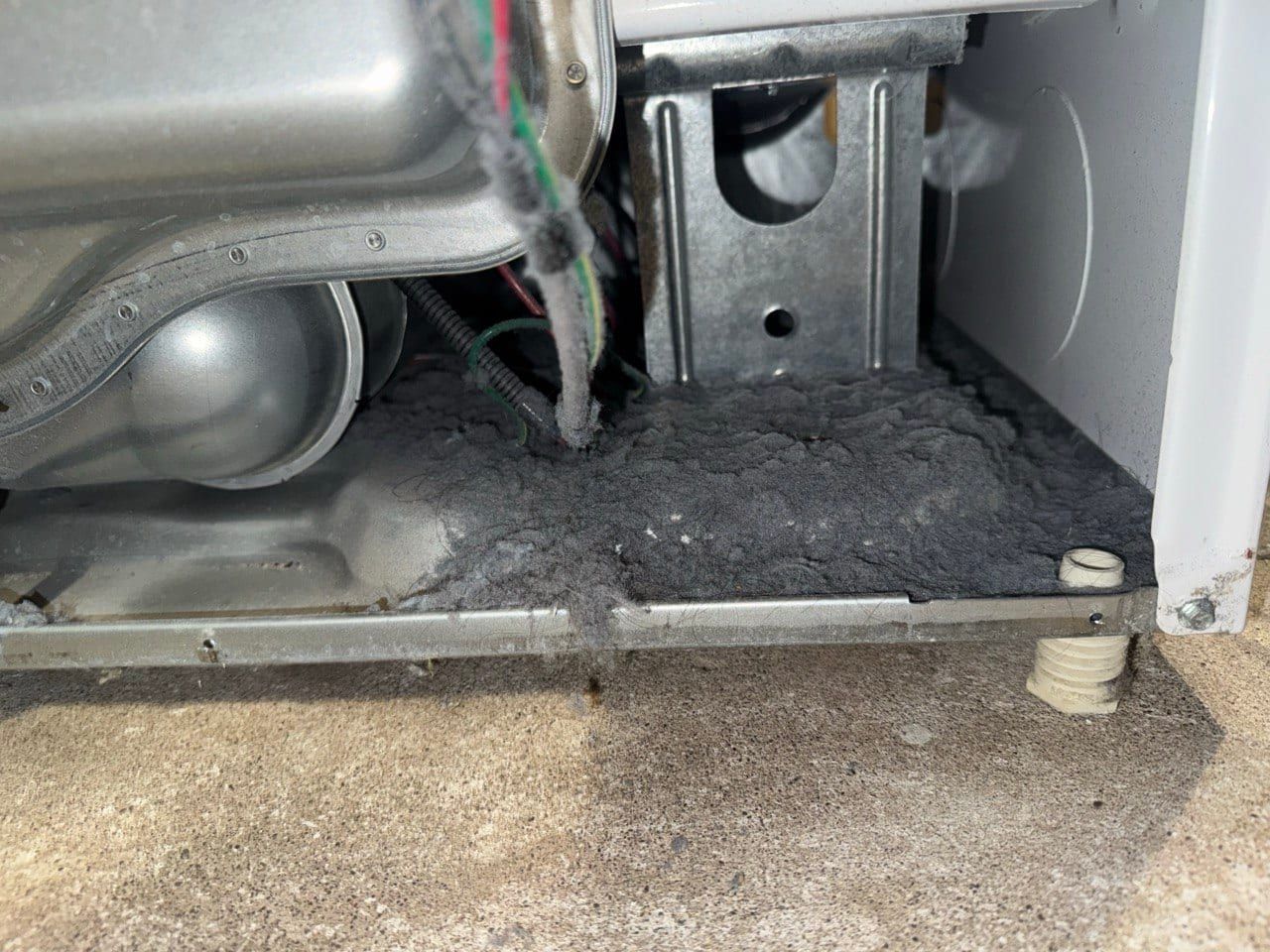
Then we went looking for the actual problem. Airflow measured at the exterior vent was roughly a third of what it should have been. Pulling the duct apart told the rest of the story: lint packed along the run, and a vent flap outside that had barely been opening.
The elbow behind the machine had also been partly crushed when the dryer was pushed back into place — common, and it makes an already restricted duct worse.
The fix
Four things, and only one of them was a part in the traditional sense:
- Full duct run cleared, from the machine through to the exterior vent — not just the first metre reachable from behind the dryer.
- Exterior vent flap freed and cleaned so it opens properly under airflow.
- Crushed elbow replaced with a semi-rigid section that will not collapse when the machine is pushed back.
- Thermal fuse and cycling thermostat replaced, because the thermostat had been through the same overheating events and was no longer reliable.
Then a full heat cycle with airflow measured again at the vent — this time within specification. Eighty minutes on site, and most of the value was in the ducting rather than the parts.
Outcome
The dryer has run normally since, and drying times are noticeably shorter than they were even before the fault, which the owner had stopped noticing over the years.
The last guy replaced the fuse in twenty minutes and left. I thought that was efficient at the time.
There is a safety point here that we do not soften. Lint is combustible, and a restricted duct against a heating element is how dryer fires start. The fuse blowing is the machine protecting itself, and the correct response is to remove the reason it had to.
We clear the vent as part of diagnosing any no-heat fault rather than billing it separately. Fitting a new fuse into the same restricted airflow is not a repair — it is a delay.
Total: $214 before HST, including the duct work, covered by our 60-day parts and labour warranty.
Cost breakdown
| Service call & diagnostic | $120 |
|---|---|
| Parts | $52 |
| Labour | $42 |
| Total (before HST) | $214 |